


Begin with the people who matter
A wedding portrait list works best when it describes relationships rather than an endless succession of arrangements. Start with the people whose presence you want to remember together. A friend who helped raise you may belong in the central family photograph; an impressive venue detail may matter much less. The useful question is what a future viewer should understand about the gathering, including the connections that would otherwise be invisible.
Imagine a couple, Maya and Luis, making their list. Instead of copying a generic sequence, they write down the households, friendships and generations they want represented. Their document becomes a planning conversation. It can also reveal omissions early, while there is time to ask someone how they would like to participate.
Give every grouping a clear purpose
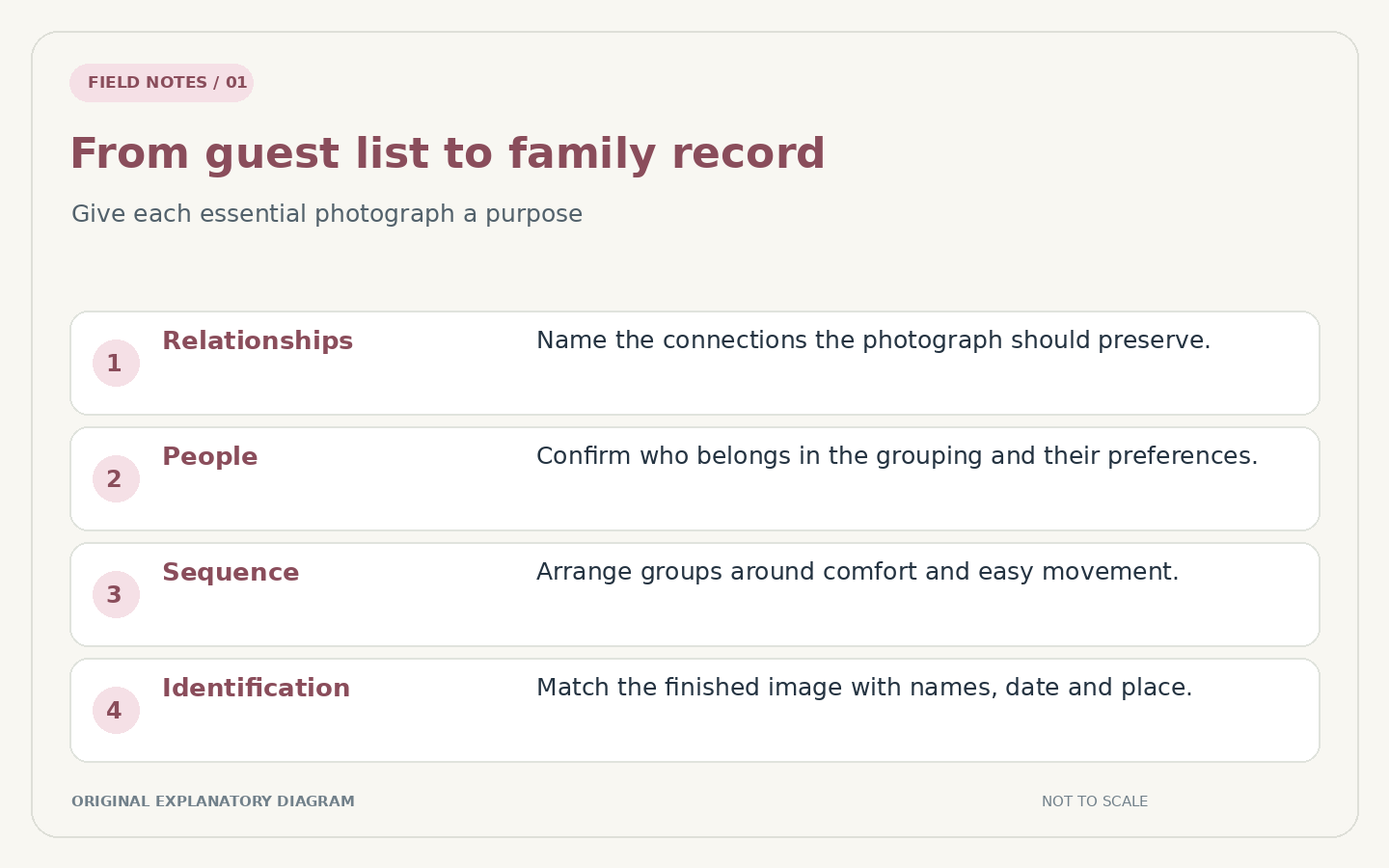
Describe each essential photograph in a short sentence: Maya with the relatives who travelled together, Luis with his childhood friends, or both partners with the people who supported the ceremony. Then list the names needed for that photograph. A purpose makes it easier to combine duplicates without quietly dropping someone important.
Separate essential groups from combinations that would simply be pleasant if time allows. This is a production choice, not a ranking of people’s worth. If the ceremony runs late, the photographer can still deliver the core record. The couple should make these choices before the day, when they can think without an audience waiting for instructions.
Ask about participation before arranging bodies
Offer people a way to mention practical needs privately. Someone may prefer a seated arrangement, need help reaching a garden, want to avoid being next to a particular person, or simply decline a photograph. Asking what would make participation easier often produces more useful information than requesting a diagnosis or an explanation of family history.
Consider two versions of a group with an older relative: one at a nearby table and another at a distant staircase. The first might provide the same relationships with much less movement. Put that option on the plan from the start. A photograph does not become more meaningful because its participants endured an inconvenient location.
Choose one gathering point and one caller
Agree on a recognisable meeting place that does not block an entrance or require guests to search several rooms. Ask a willing person who knows the group to call names. Give that helper the current list, rather than expecting the photographer to identify every cousin by sight while also setting up the picture.
Arrange the sequence around who needs to stay, not around the alphabetical order of the list. For example, make the largest family grouping first, then let people leave as smaller combinations remain. A helper can quietly locate the next participants while the present photograph is taken. Avoid announcing private reasons for anyone’s early departure.
Give the helper permission to mark a grouping complete and record any agreed substitution. If an absent guest arrives later, the note prevents an unnecessary repeat of every arrangement. Keep the working list discreet: it needs names and practical instructions, not sensitive explanations. The final family index can be made separately after the event, with private planning notes removed.
Preserve names while they are easy to confirm
The Smithsonian Archives recommends identifying people, dates and places in family photographs, with enough detail to distinguish relatives who share names. That advice becomes much easier to follow when identification starts at the event rather than decades later. A portrait list can provide the first draft of an album index. [1]
After the photographs arrive, match the essential groups to their file names. Record people from left to right and note who supplied the identification. If two relatives disagree about a name, preserve the uncertainty until it is resolved. Do not silently convert an uncertain recollection into a permanent caption merely because a blank field looks untidy.
Plan for the photograph nobody expected
Leave space for an unplanned grouping: friends laughing beside a coat rack, two relatives helping with a jacket, or a conversation between people who rarely meet. These images may reveal the event’s character more clearly than another formal arrangement. A useful list protects important photographs while leaving the photographer room to notice what actually happens.
The couple can distinguish a requested record from a forced performance. Asking for a photograph of two friends together is different from requiring them to recreate a private emotional moment. If a spontaneous scene has ended, a later portrait can still be valuable without pretending to document the earlier exchange exactly as it occurred.
Decide where photographs may travel
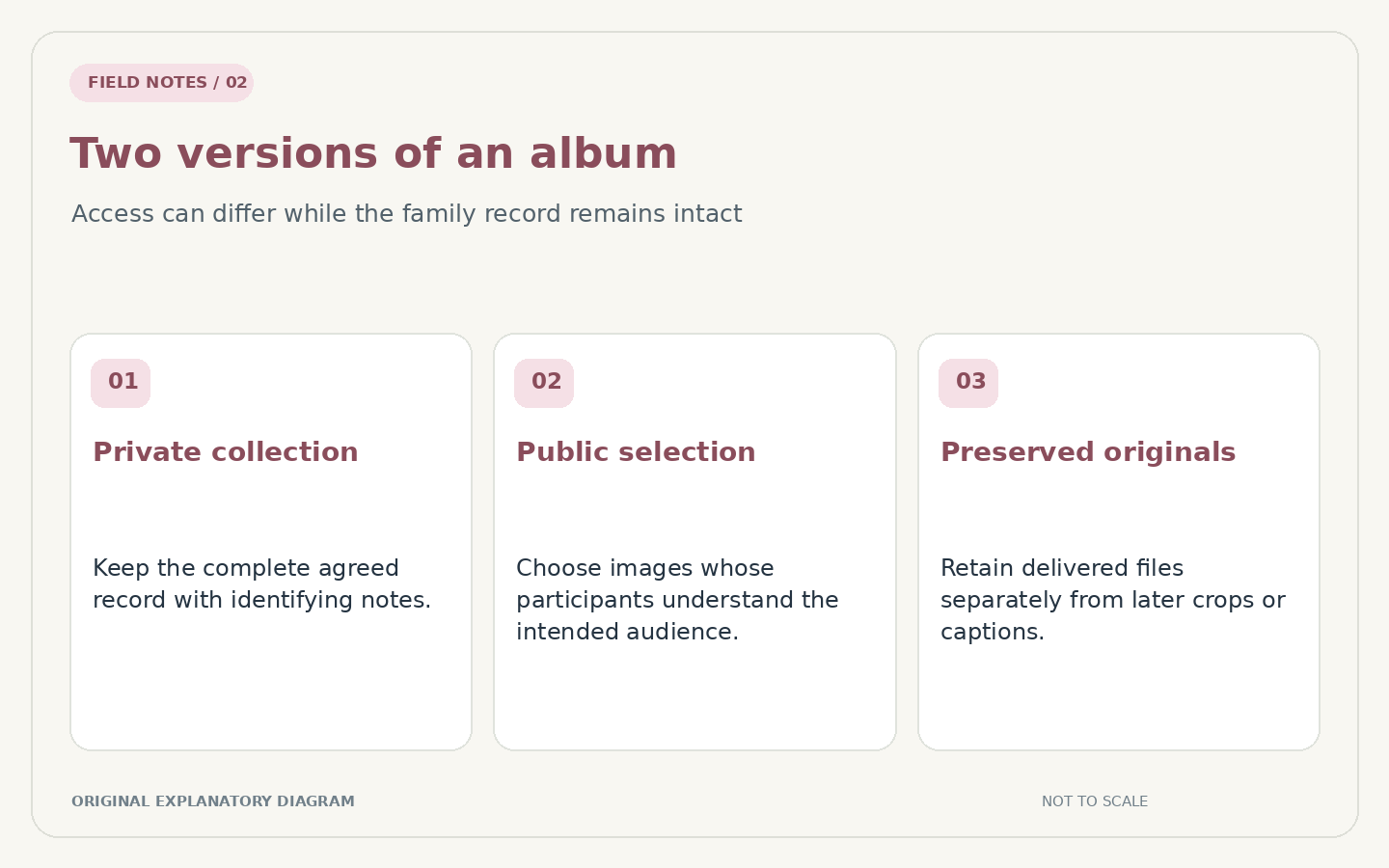
Discuss the difference between an album shared with relatives and a public gallery. A person may be comfortable appearing in the first and uncomfortable in the second. Write down the agreed destination for any sensitive grouping so that the person choosing public images later does not have to reconstruct the conversation from memory.
For a practical example, the couple might keep a complete private album while preparing a smaller public selection. That does not require removing people from family history. It simply recognises that different audiences need different access. A memorable image can remain meaningful even when it is not used to promote an event or attract attention online.
Keep a usable copy beyond the gallery
The Library of Congress recommends identifying valuable digital photographs, organising them with descriptions and making copies. A delivery gallery is convenient for viewing, but the family should also know where its own files and descriptive information are kept. Preservation becomes a manageable household task when one person owns the next action. [2]
Choose a folder name that will still make sense to someone who did not attend. Include a plain document with the event date, location, photographer credit and group identifications. Preserve the delivered originals separately from cropped or annotated versions. Ask a second family member to open the collection, because a successful download is not the same as a usable archive.
Review the record with another generation
Before calling the project complete, show the album to someone outside the planning group. Ask whether they can identify the central people and understand why particular photographs belong together. Their questions may reveal missing names, an unexplained relationship or an important person who appears only in the background.
This final conversation need not turn the wedding album into a formal research project. It gives the photographs a durable starting point. The finished portrait list has done three jobs: it helped people gather, helped the photographer use limited time and helped future viewers recognise the relationships. Those outcomes matter more than the number of combinations crossed off on the day.
Sources
- Six Tips for Preserving Family Archives — Smithsonian Institution Archives
- Four Easy Tips for Preserving Your Digital Photographs — Library of Congress


